
Coastkeeper’s Green Abalone Restoration Project
restores green abalone in their native marine rocky reef and kelp forest habitats throughout Orange County, which are classified as NOAA Trust Resources.
Orange County Coastkeeper is one member of a larger coalition of partners in Southern California working in coordination with the National Marine Fisheries Service (NMFS), National Oceanic and Atmospheric Administration (NOAA), and the California Department of Fish and Game (CDFG) to restore populations of this and other species of abalone throughout Baja Mexico and Southern California.
The project aims to not only restore but also to educate the public about the importance of this species and the significant economic, ecological, and recreational benefits of developing cooperative and effective conservation and management efforts for all species of abalone along the southern California coast.
As of March 2011, Coastkeeper and other Orange County coalition members have collected 26 abalone tissue samples (without harming or removing the animals). This number may seem small, but take into account the difficulty of finding these little buggers given the small population. We continue to collect samples throughout the month of April. Once genetic testing is complete, we will know whether or not we will be able to introduce hatchery-raised abalone into the wild to enhance native populations.
Thank you to all of our donors and volunteers for your help!
What is an Abalone?
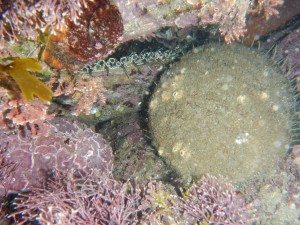
Abalones are small to large sea snails (marine gastropod mollusks) that are found in coastal waters of nearly every continent. On the outside this animal may seem rather uncharismatic and obscure as it blends in very well with the algae-covered rocky reefs of the coastal surf zone and looks more like a rock than a living animal. You may call it the “tortoise of the sea” as it is very slow moving as it grazes the algae on the reefs. However, abalone have played an important part in California coastal culture. Native Americans used abalone for food and trade, and the commercial abalone fishery in southern California employed thousands of workers.
 Any native Californian older than 40 can remember the time of abundance of abalone, and for many it was a common beach activity to recreationally fish abalone and collect their shells, which have a mother-of-pearl coloring, making them highly desirable as jewelry and other decorative objects. Today, scuba divers and ocean lovers from around the world travel to Southern California, particularly Orange County and Catalina Island, to experience one of the most beautiful and unique underwater ecosystems in the world, which also happens to be the home of this equally unique animal.
In addition to its value to commercial and recreational fisheries, abalone is a key component of the overall health and function of the shallow rocky reef ecosystem in which they are found. Abalones are important herbivores in the marine food web feeding mainly on kelp and other species of algae. They help to control certain populations of algae growing on reefs. Abalone is also an important food source for lobsters, crabs, octopuses and other species. Abalones compete for food and space with sea urchins and thus help to control urchin populations. Urchin populations, if left unchecked, contribute to the destruction of kelp forests as they prefer to munch on kelp holdfasts, which anchor this giant brown algae to the seafloor.
Historically five species of abalone (red, pink, green, black and white) were abundant in California coastal waters, and supported both commercial and recreational fisheries. Stock collapse due to commercial and recreational fishing pressure, disease and parasites, predation, and environmental factors, including water quality, led to the closure of all abalone fisheries in southern and central California in 1997. Abalone are slow-maturing animals and thus more susceptible to overfishing. Abalone populations have not since recovered and today only northern California’s red abalone sport fishery remains. Without concerted efforts to encourage abalone restoration, the disappearance of all species of abalone from the Southern California coast is likely.
Abalone Biology
Depending on the species, abalones occur from the intertidal area to depths of 200 feet. The green abalone, the focus of Coastkeeper’s current project, appear in coastal waters between the low tide line and approximately 18 meters in depth. Abalones are characteristically found in rocky reef habitats where they can easily find kelp and other species of algae (their main food source) and hide from predators, which include lobsters, octopuses, and sea otters.
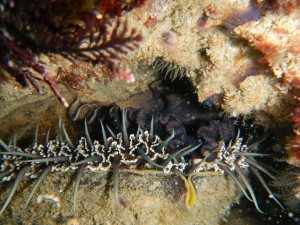
Green abalone can grow to be 60 to 130 millimeters (2.4-5 inches) long when fully developed. You may be able to tell them apart from the pink abalone, which has black tentacles and a highly corrugated shell margin, by looking closely for the green abalone’s olive green tentacles and brown and cream-colored frilly-looking epipodium (surrounding the tentacles at the base of the shell in the photo).
What’s Being Done?
California has recognized that abalone populations are depleting at a swift pace; and if this pace keeps up, the state’s abalone species will disappear. To address this threat, the State Legislature directed the California Department of Fish and Wildlife to develop a plan for the recovery and management of abalone populations.
The Abalone Recovery and Management Plan (ARMP) was developed in 2005 and updated in 2011. The ARMP is the foundation for abalone restoration in California, and will guide the activities of the Coastkeeper project.
Project Area
Coastkeeper plans to restore green abalone in the rocky intertidal and kelp forest areas of Orange County from Corona Del Mar in Newport Beach to Dana Point. This area holds the best habitat for abalone in Orange County, and held large numbers of abalone through the early 1970’s.
Project Goals
The main focus of our project is to provide direct benefits to green abalone (Haliotis fulgens). Specifically, the project will contribute to the recovery of this species by establishing Minimum Viable Population(s) (MVP) density.
Another important project goal is the testing and development of the proposed efficient, non-regulatory and cost-effective restoration methods credited to this project. The data derived from this project will inform future efforts with green abalone and possibly other abalone species by identifying the ideal age class(s) and depth(s) for out-planting green abalone in Los Angeles and Orange Counties.
Partnerships
As Coastkeeper leads the effort in green abalone research towards restoration in Orange County, it is important to note that our project is part of a larger endeavor being taken up by NGOs throughout southern California. OCCK works with a number of partners in this regional program, including:
National Oceanic and Atmospheric Administration (NOAA)