Eelgrass Restoration in Upper Newport Bay


Live video from your Android device on Ustream Coastkeeper eelgrass friends can now spend endless hours (or at least from 8am – 5pm PT) watching the eelgrass beds and guest appearances from eelgrass “residents” in this live fish webcam,  brought to you by the Montrose Settlements Restoration Program (MSRP). The webcam is located in Talbert Marsh within the Huntington Beach Wetlands in California. Brookhurst and Magnolia marshes that are connected to Talbert Marsh were recently restored by MSRP and NOAA.  Wetlands provide critical habitat for many commercial and sport fish species when they are in their younger and adult life stages. Live views of many different fish and invertebrate species can be seen from this webcam. An image gallery of the species we have observed is below. Tune in especially during low and high tide cycle changes to see more fish activity – NOAA Montrose Settlements Restoration Program. 

Fish webcam is down?  Watch a 10 minute clip.

Tell us what fish you’ve seen!  Fill out the Fish Webcam Observation Sheet!

Great News from the First Eelgrass Survey of the Year!

A Navanax sea slug "hanging out" in the newly-transplanted bundle area!

On December 7, 2012, Coastkeeper Marine Restoration Coordinator, Amanda Bird, and Senior Marine Biologist, Rick Ware, of  Coastal Resources Management, Inc along with our fantastic Coastkeeper Captain, Austin Brown, performed the first underwater surveys of the restored eelgrass beds since restoration. We are happy to report that the restored areas consisting of one area in which we transplanted bundles, one in which we laid TERFS, and a third in which we used the Buoy-Deployed Seed bags, are all looking healthy for a newly-transplanted bed (see below for more information on the methods used). The bundles have grown into a natural-looking bed and most all of the bare patches have filled in and expanded to new areas on the previously unvegetated mudflat. All of the TERFS are now small patches containing eelgrass, which has also begun to spread to cover the area. There are small patches of seedlings present in the BuDS areas, which we are hopeful will continue to grow and expand until next Spring when we survey the areas for the second time before round two of restoration.


Our volunteers hard at work!

Phase I of Restoration is Complete!

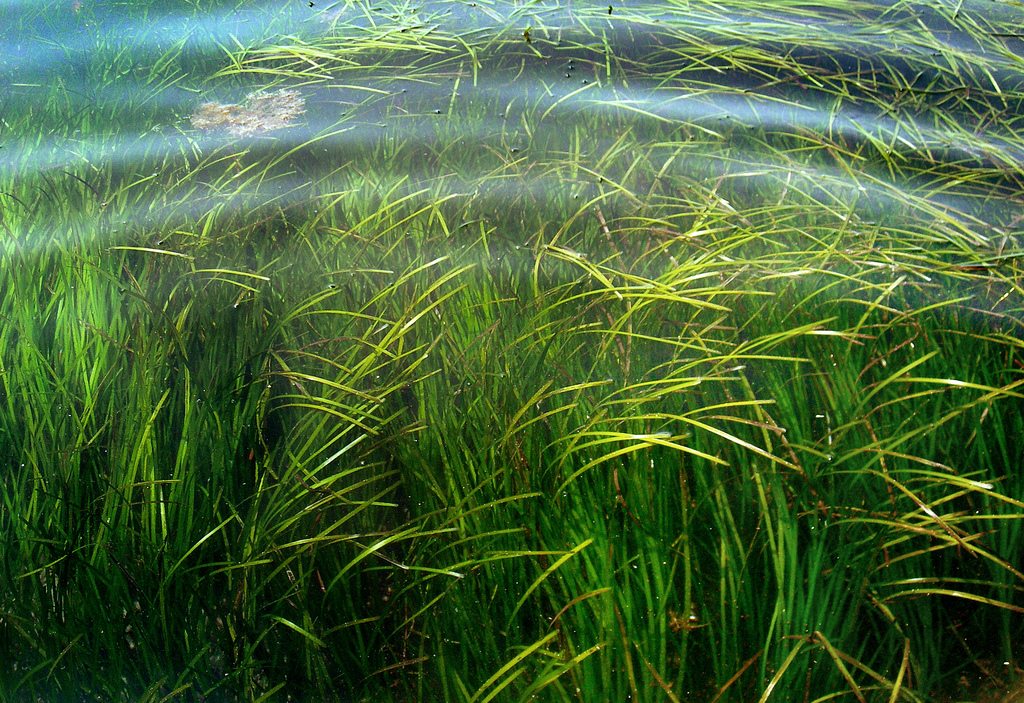
After years of research, planning and community outreach, Coastkeeper (in partnership with Coastal Resources Management, Inc. and the Department of Fish & Game) completed the first phase of our pilot eelgrass restoration project. Over 40 land-based volunteers and volunteer divers worked over the course of four days in late June to restore this native seagrass to Upper Newport Bay. Together, we were able to restore 200 square meters (2,100 square feet) of eelgrass in Upper Newport Bay.

Everyone got wet, everyone got muddy, and everyone was able to see the product of their hard work as volunteers got to view the restoration site and help deploy our two restoration methods, TERFS (eelgrass tied to wire frames) and BuDS (bags of eelgrass seeds tied to buoys and anchored to the bay floor). See more pictures on Facebook!

DeAnza Peninsula in Upper Newport Bay

One of the project goals is to evaluate three different restoration methods and determine which is the most successful, cost-effective, and requires involvement from the community. Volunteer divers worked tirelessly to collect eelgrass by hand in natural eelgrass beds in the lower bay and to plant each bundle by hand, lay each TERF, and help volunteers position BuDS buoys in line. We successfully built over 150 bundles, 20 TERFS frames, and 20 BuDS buoys.While the transplant was a huge success, we will be evaluating the success of the first transplant over the next 12 months.

Next year in June, we will begin round two and plant an additional 400 square meters (4,300 square feet) of eelgrass in the same area using only the most effective transplant methods.


Quick Links:

Project Funders and Partners:


In The News:

History Of The Project

Orange County Coastkeeper partnered with Rick Ware, President and Senior Marine Biologist of Coastal Resources Management, Inc., and the Department of Fish and Game staff at the Back Bay Science Center in Newport Beach to undertake an innovative eelgrass restoration project, the largest in Upper Newport Bay. The first phase of the four-year restoration project will began in early summer 2012, and has been made possible through funding from the National Oceanic and Atmospheric Administration (NOAA) Restoration Center’s Community-Based Restoration Program and the State Coastal Conservancy.

The project was originally conceived as a response to the need for more research and data on effective restoration and management methods for eelgrass in Upper Newport Bay, which had declined in the upper bay due to poor water quality and other factors. Between 2008 and 2011, Coastkeeper received funding from both the City of Newport Beach, the California Coastal Commission, and the U.S. Environmental Protection Agency Environmental Education grant program to implement an eelgrass education and research program at the Back Bay Science Center in partnership with the Department of Fish and Game.

Through the project, over 3,000 students and community members throughout Orange County have participated in hands-on eelgrass and wetland activities at the Science Center. The goal of the educational project is not only to increase public awareness of the importance of eelgrass in the bay, but also to involve our students in local environmental issues and get them excited about science and concepts taught in the classroom. To read more about the eelgrass education project check out the Newport Bay Eelgrass Project page!

Restoration Methods (The COOL Part!)

One of our primary goals of this project is to evaluate the success and cost-effectiveness of three different methods of eelgrass restoration — the bundling method, TERFS (Transplanting Eelgrass Remotely with FrameS) and BuDS (Buoy-Deployed Seeding). These methods have been used extensively and with varying amounts of success on both the East Coast and in Puget Sound.

The Bundling Method

Eelgrass collected by divers from nearby natural “donor” beds is separated into bundles of 10-12 shoots of eelgrass by hand and held together using biodegradable hemp string and a tongue depressor, which acts as an anchor to keep the bundle in the sediment once planted. This process takes place on land and is an effort largely accomplished by our many dedicated volunteers who love to get muddy! The bundles are transported to the restoration site on boards and gently transplanted into the soft bay sediment by our staff and volunteer scientific divers. This method has been used very successfully in Newport Bay for many years to establish new beds.

Photo by CRM, Inc.

Bundles on transport board

A newly-transplanted bundle


Transplanting Eelgrass Remotely with FrameS (TERFS)

This method was developed by Dr. Frederick Short at the University of New Hampshire. The idea involves tying eelgrass to sturdy frames on land, which can then be easily lowered either by divers or from a boat into the restoration area. The frames are ideal for reducing erosion around transplants and anchoring the grass into the sediment until it can take root, particularly in areas with stronger current, such as that in our restoration site.

Tying eelgrass to TERFS frames

A newly-placed TERF

TERF after burying the rhizome

Buoy-Deployed Seeding (BuDS)

This method was originally designed and successfully implemented by Chris Pickerell through Cornell University and SeagrassLI.org. Rather than removing entire eelgrass plants from donor beds, only the flowering portions of an eelgrass plant are removed and placed by land-based volunteers into mesh bags. These bags are then tied to a buoy on the surface of the water, which is anchored to the seafloor using concrete blocks. The bags act as a vessel to disperse seeds into the water column, which drop to the seafloor and develop into new plants! This method typically requires one year to see significant results.


Volunteers picking flowers and filling BuDS bags

BuDS buoy sitting at the restoration site

Eelgrass flowers in BuDS bag

The intent of using these different methods is not only to evaluate the success and cost-effectiveness of each, but also to develop methods that can be safely and easily undertaken by the community. It is an effort to involve concerned local citizens in the preservation of this vital natural resource and we hope to see success with each method!

Long Term Goals:

  • Establish sustainable eelgrass habitat in Upper Newport Bay
  • Evaluate success of multiple restoration methods
  • Develop site-selection and success criteria for future restoration projects
  • Develop a sustainable community eelgrass restoration education and outreach program at the Back Bay Science Center

Expected Benefits:

Ecological Benefits

  • Increase diversity and abundance of species native to Newport Bay estuary
  • Restore critical ecosystem services

Economic Benefits

  • Restore the value of Upper Newport Bay as a recreational and commercial fishery habitat
  • Restore the monetary value of eelgrass habitat based on ecosystem services provided

Social and Educational Benefits

  • Increase educational opportunities and public awareness of the importance eelgrass

“Without strong public support for seagrasses and the uncharismatic but highly productive animals they shelter, conservation efforts will continue to lag behind those of other key coastal ecosystems” (Orth et al. 2006).

Made Possible By:


Related Pages…

 Newport Bay Eelgrass Project

Eelgrass education at the Back Bay Science  Center from 2009 through 2011!

 What is Eelgrass & Why is Eelgrass Important?

Do eels live in it? Why do we care about this “invisible” plant  that grows in the bay? Well, for starters, it’s  our own mini-rainforest!

Threats to Eelgrass Habitat

What threatens this precious habitat?

 Eelgrass in Newport Bay

Where does eelgrass grow in the bay and  why?