The region’s biggest source of copper and zinc pollution operates entirely beyond the reach of enforceable clean-water mandates
Today, California Coastkeeper Alliance, Inland Empire Waterkeeper, and Orange County Coastkeeper filed a petition with the Santa Ana Regional Water Quality Control Board to reduce stormwater pollution from privately owned commercial, industrial, and institutional sites that generate runoff into the Chino Creek watershed in San Bernardino and Riverside Counties.
Under the federal Clean Water Act, private organizations like Waterkeeper can petition regulators to address regulatory gaps that lead to water pollution. Hundreds of privately-owned properties throughout the Inland Empire — including massive logistics and warehousing campuses, retail centers, and industrial facilities — are not being held accountable for their disproportionate contributions to toxic metal pollution in Chino Creek and its tributaries.
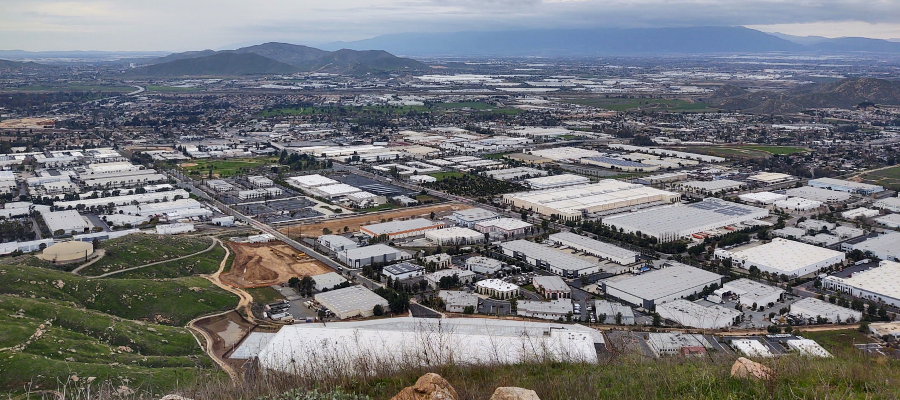
The petition demonstrates that the Santa Ana Regional Water Board must exercise its authority under the federal Clean Water Act to require stormwater permits for privately-owned commercial, industrial, and institutional — often referred to as CII — sites throughout the Chino Creek watershed, including Cucamonga Creek, San Antonio Creek, and Upper Chino Creek.
Under current law, municipalities — not private commercial property owners — bear the legal and financial burden of addressing stormwater pollution. The Santa Ana Regional Board’s Municipal Separate Storm Sewer Systems (commonly known as MS4) permit program regulates the public storm drain system, but it does not directly require the private CII facilities that generate a disproportionate share of pollutants to reduce their discharges. That gap has a direct consequence: CII sites generate approximately 61% of the watershed’s copper pollution and 60% of its zinc pollution while bearing zero enforceable obligation to reduce those loads. Therefore, municipalities cannot achieve water quality standards no matter how stringently they are regulated — they simply do not control enough of the pollution.
“Commercial and industrial sites occupy just 28% of the urbanized watershed, yet they generate over 60% of the metal pollution found in the water — metals that are poisoning Chino Creek, Cucamonga Creek, and the Santa Ana River,” said Garry Brown, Founder and President of Inland Empire Waterkeeper and Orange County Coastkeeper. “This watershed is home to one of the largest logistics and warehousing regions in the United States. Those facilities have benefited from a regulatory blind spot for decades. That ends now.”
The Clean Water Act’s Residual Designation Authority is designed precisely for situations like this. Once a regulator determines that a category of stormwater discharges contributes to a violation of a water quality standard or is a significant contributor of pollution, it is legally obligated to require permits for those discharges. The Waterkeepers argue that the evidence of CII contribution to pollution in the Chino Creek watershed is overwhelming and mandatory designation is required.
The petition demonstrates that CII sites in the watershed contribute approximately 1,660 pounds per year of copper and 8,800 pounds per year of zinc to receiving waters — roughly 16 times and 30 times the copper and zinc the entire 139,520-acre Chino Creek watershed would generate under natural, pre-development conditions. Approximately 73–80% of this CII land area lies within a half mile of Cucamonga Creek, San Antonio Creek, or Upper Chino Creek — meaning pollutant-laden runoff reaches impaired waters rapidly and with minimal attenuation, particularly across the flat Cucamonga Plain where the region’s densest logistics corridors are concentrated.
“Regulators have both the authority and obligation to require permits for commercial, industrial, and institutional stormwater discharges that are polluting local waterways,” said Sean Bothwell, Executive Director of California Coastkeeper Alliance. “Our petition demonstrates that similar action is not only justified here, but urgently needed across California to ensure private corporate polluters – not the public – are on the hook to address these water quality violations.”
This petition follows a directly analogous precedent: in November 2024, EPA Region 9 determined that permits are required for CII stormwater discharges in the Dominguez Channel and Alamitos Bay/Los Cerritos Channel watersheds in the Los Angeles area — watersheds facing comparable conditions of CII-driven metal impairment. The Chino Creek watershed presents conditions that are in some respects more acute, particularly given the extraordinary concentration of large-footprint logistics and industrial facilities in the Cities of Ontario and Rancho Cucamonga.
Under federal regulations, the Regional Board must act on the petition within 90 days, determining whether to require new stormwater controls for major CII dischargers. If the Board designates these sources for regulation, hundreds of facilities in the Chino Creek watershed would need to obtain Clean Water Act permits and implement measures such as on-site green infrastructure, stormwater capture and reuse, treatment systems, or funding for regional projects — actions that would not only reduce pollution but also advance regional water supply reliability and drought resilience goals.
California Coastkeeper Alliance filed similar petitions at six other Regional Water Boards across California today. The organization is also working with State legislators and the State Water Resources Control Board to encourage development of a statewide policy and permit that would hold commercial, industrial, and institutional facilities accountable for the water pollution generated on their properties, with the goal of requiring commercial landowners to make the investments needed to protect public waterways from pollution generated on private property.